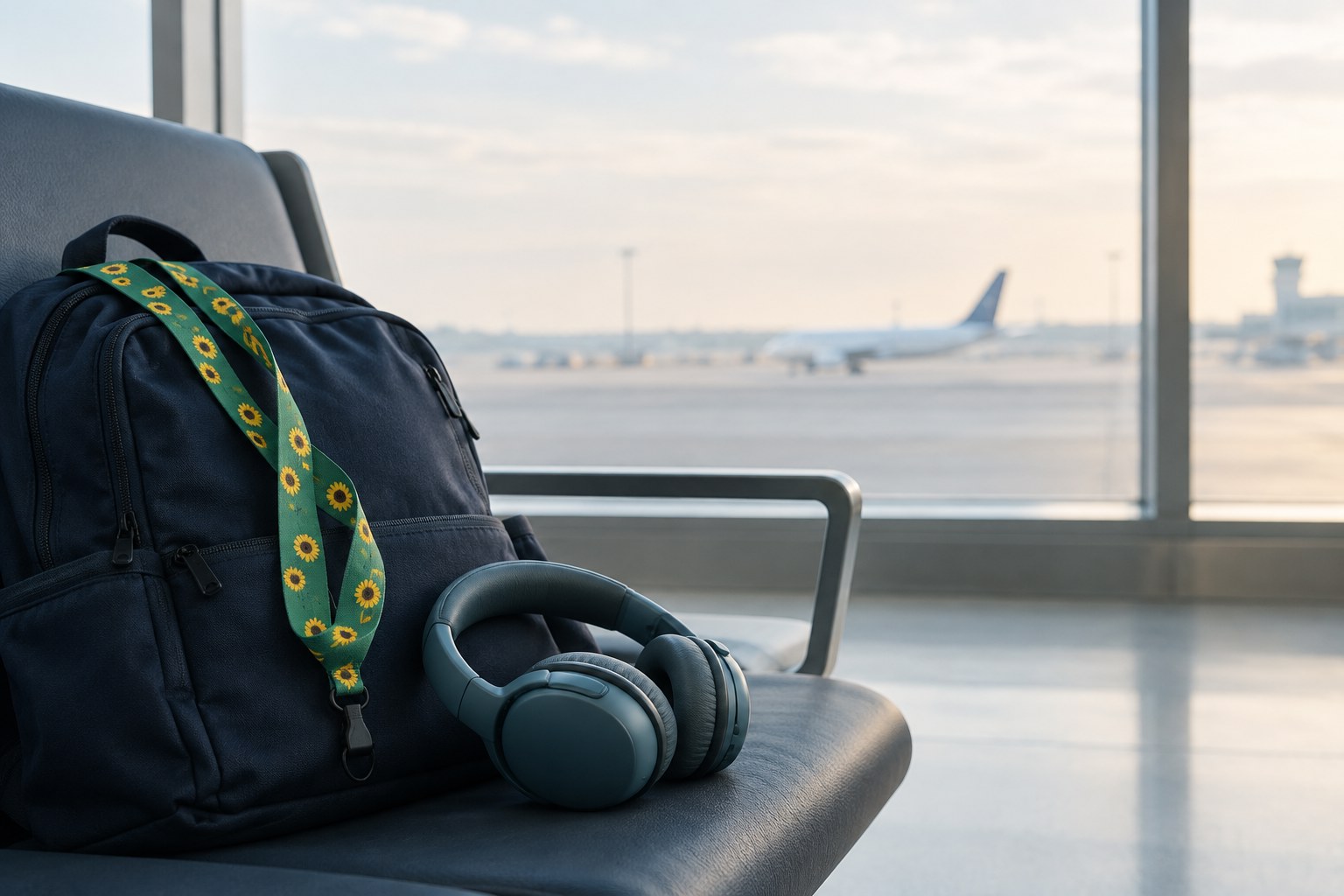
A green strap printed with small yellow sunflowers. You’ve probably seen one at an airport security queue, a supermarket checkout or a train station. Maybe someone in your family has started wearing one. Maybe you’ve wondered whether you should.
The Hidden Disabilities Sunflower is one of the simplest accessibility ideas of the last decade, and one of the most misunderstood. Some people treat it as a pass that guarantees special treatment. Others dismiss it as a feel-good gesture that changes nothing. Neither is right. For autistic people and their families, the sunflower lanyard works best when you know exactly what it is, and exactly what it isn’t.
What the sunflower actually means
The scheme started at Gatwick Airport in the UK in 2016. According to the Hidden Disabilities Sunflower organisation, it is now recognised in more than 95 countries. The idea is simple: the sunflower is a quiet signal that the wearer has a disability you can’t see, and may need more time, patience or support.
That’s it. It doesn’t say what the disability is. It doesn’t say what kind of help is needed. It just opens a door. Staff at member organisations are trained to respond with a question, roughly “How can I help?”, rather than an assumption.
For a lot of autistic people, that small shift matters more than it sounds. It means not having to explain yourself, out loud, in a noisy queue, to a stranger, at the exact moment your capacity to explain is lowest.
You don’t need proof, and you don’t need permission
This is the part people most often get wrong. The organisation is explicit: you do not need to provide any proof of disability to wear a sunflower or to ask for support. There’s no qualifying list of conditions. Wearing it is a personal and voluntary choice, and you decide when.
That matters for autistic adults who are self-identified or still on a years-long assessment waiting list. It matters for parents of a child who isn’t diagnosed yet but who falls apart in departure lounges. And it matters for anyone who only wants to wear it on bad days. You can wear it to the airport and take it off at the hotel. Nobody gets to audit that.
Lanyards are generally handed out free by member organisations, such as airports, rail operators and supermarkets. Ask at an information desk before you buy one online.
What it can’t do on its own
Here’s where we need to be honest. The sunflower is a signal, not a right. It doesn’t create a legal entitlement to anything. A shop that isn’t a member may not recognise it at all. Even at a member organisation, a busy, stretched member of staff may not notice it. And it can’t tell anyone that you need them to stop talking, or that the tannoy is the problem, or that you need to sit on the floor for five minutes.
So treat it as the first sentence of a conversation, not the whole conversation. The people who get the most from it tend to pair it with something more specific.
- A short card. Two or three lines: “I’m autistic. I may not answer quickly. Please speak plainly and give me time.” A printed card or a note on your phone both work.
- One concrete request. “Can we wait somewhere quieter?” is easier for staff to act on than “I need support.”
- A plan for when words go. If you or your child may lose speech under stress, have the card, a typed phone note or an AAC device ready before you reach the front of the queue.
Where it carries the most weight: travel
Airports are where the sunflower has its strongest footprint. The organisation lists more than 200 airports among its members, alongside rail, coach, bus and ferry operators.
But the sunflower is not the same thing as booking assistance, and that’s the bit families often miss. In the UK and the EU, airports and airlines have a legal duty to provide special assistance to disabled passengers, and the Consumer Council for Northern Ireland confirms that this covers hidden disabilities including autism. It must be free. The catch: it’s only provided if you ask, and you should request it at least 48 hours before you travel, ideally when you book.
That assistance can mean a quieter route through security, help with boarding, or a seat in a calmer area while you wait. The lanyard helps staff recognise you on the day. The booking is what makes sure there’s a plan.
Other countries have their own routes. In the US, TSA Cares helps travellers with disabilities through security screening, and recommends contacting them at least 72 hours before departure. The sunflower launched in Australia, New Zealand and North America in 2020, and recognition has grown since, but it varies from airport to airport. Check your departure and arrival airports’ accessibility pages before you go, not when you land.
Should you, or your child, wear one?
There’s no right answer, and you’re allowed to change your mind.
Some autistic adults find it freeing. It removes the need to disclose in detail, and it quietly shifts the burden of adjustment from them to the environment. Others feel exposed by it, or worry about being treated as less capable. Both reactions are reasonable. Disclosure is always a choice, and a visible symbol is a form of disclosure.
For children, a few questions help:
- Does your child mind wearing something around their neck? For some sensory profiles, a lanyard is itself the problem. Ask whether a badge or wristband version is available, or skip it and rely on a card instead.
- Is your child old enough to have a view? If so, ask them. It’s their body and their disclosure.
- Will you be there to explain? A young child wearing a lanyard alone tells staff something, but not enough. The adult with them still has to do the talking.
If you’re an adult preparing for a hospital stay or a medical appointment, the same logic applies. The sunflower can get you noticed. A written plan gets you understood. We cover that second step in detail in our guide to going into hospital as an autistic adult.
The bigger point
The sunflower works because it changes who has to do the work. Instead of an autistic person having to perform distress convincingly enough to be believed, the environment is asked to slow down and offer help first. That’s a small reversal, but it’s the right direction.
It isn’t a fix for loud airports, rushed staff or public spaces built with one kind of brain in mind. Those still need changing. In the meantime, a strip of green fabric, a short card and a booked assistance request can turn a dreaded journey into a manageable one. That’s worth knowing about.
Keep reading
How public spaces, services and cultures respond to autistic people, and how to ask them to do better, is the heart of Laura Mitchell’s Where Autism Meets the World. It looks at autism beyond the home and the clinic: in schools, workplaces, communities and countries that each handle difference in their own way.
This article is general information, not legal or medical advice. Rules on travel assistance vary by country and provider, so check with your airline, airport or transport operator before you travel.